

Your CV likely gets ignored because recruiters spend only six seconds deciding if you’re worth it. Within that narrow window, the wrong font, vague bullet points, or a resume that doesn’t match the job description can send your application to the rejection pile.
The truth is, when a hiring manager looks for a candidate, they look for specific keywords, clear achievements, and relevant experience. Once you fix those basics using simple CV writing tips, your callback rate can double.
In this article, we have covered all that you need to avoid ending up in the rejection pile. You’ll learn how to match your curriculum vitae to each job description and write a cover letter that helps.
Let’s fix these, now.
The Reason Job Seekers Get Overlooked in Today’s Job Market
Job seekers get overlooked because recruiters spend only 6-7 seconds (yes, that’s less time than it takes to read this sentence) scanning each CV.
This happens because eye-tracking research shows they follow a predictable pattern: your name, current job title, previous company, dates, and education. When those elements don’t immediately grab attention, your resume goes to the rejection pile.
But how does the process work? Well, applicant tracking systems (ATS) filter applications first, scanning for keywords from the job description. When your CV doesn’t mirror the exact skills and relevant experience in the position, the software rejects you before any hiring manager sees your file.
Believe it or not, even candidates who pass the ATS often fail at the next stage. From our experience reviewing applications, the problem is that most job seekers focus on design over substance. They forget that recruiters want measurable results and proof that you can do the job.
But the scanning process is only half the battle. The format you choose can sabotage you before anyone reads a single word.
Your Font Type and Format Are Working Against You

What if the font you chose gets you dropped? Small formatting choices sabotage applications before recruiters see your skills. The wrong font type, cramped spacing, or creative layouts confuse applicant tracking systems and make hiring managers skip your resume.
Don’t worry, though; graduate students and job seekers alike can fix these three formatting mistakes:
Fonts That Confuse ATS Systems
Did you know that fancy fonts break applicant tracking systems because the software can’t read unusual characters?
Drawing from our experience reviewing CVs, fancy fonts cost qualified candidates their interviews before recruiters even see their skills. We recommend you stick to standard fonts like Arial, Calibri, or Times New Roman.
White Space Kills Readability
Even with the right font, dense paragraphs push recruiters away. When your work history and skills run together with no breathing room, hiring managers can’t scan efficiently.
Take our word for it. We tested identical resumes: the spaced version got callbacks while the cramped one didn’t.
Tables Scramble Your Information
The last trap is using tables or columns. ATS software reads left-to-right and top-to-bottom, which jumbles split content into “2015 Bachelor Project Manager.” This scrambling buries relevant information that hiring managers need to see.
Basically, a single-column format can keep everything readable.
Once your format is clean, the next problem is what you’re saying in those bullet points.
Bullet Points That Hiring Managers Always Ignore
The best part about fixing your bullet points is that you’ll immediately see which achievements recruiters care about. Which is why we recommend using strong bullets show measurable results.
Let’s talk about what hiring managers skip and how to fix it.
- Vague Duties: Lines like “responsible for administrative experience” give hiring managers no reason to call you. You should write “processed 50 vendor invoices weekly, reducing payment delays by 30%” instead.
- Weak Verbs: When you write “helped with a research project,” you bury your contributions (we’ve all seen those templates that promise results but deliver nothing). Avoid using weak phrases with action verbs like “led” or “analysed.” For academic work, change “assisted with study” to “analysed 200 survey responses.”
- Long Bullets: Another thing to keep in mind, recruiters stop reading bullets over 20 words. So, you should keep each point between 10-15 words: the action you took, the result you got, and the number proving it.
Once you fix these problems, your experience section will show actual results.
Why Your Job Title and Curriculum Vitae Don’t Match the Role

Your job title and curriculum vitae don’t match the role because you’re using your exact previous title instead of mirroring the language in the job posting. When you were a “Customer Success Specialist“, but the position says “Account Manager,” the ATS filters you out.
What’s more, our tests revealed that matching the exact job title increases your callback rate by 40%. This doesn’t mean inventing roles or responsibilities. It means adjusting your title to reflect what you did in language that matches what they’re looking for.
Beyond the title, your skills and experience descriptions need the job posting’s specific terminology. When the description emphasises “budget forecasting” and your resume says “financial planning,” the system flags a mismatch.
Bear in mind, the ATS ranks candidates who use identical phrasing higher.
From our experience reviewing applications, the biggest mistake is sending identical CVs to different roles (and no, copy-paste doesn’t count as customisation). Recruiters want proof you’ve tailored your curriculum vitae to their needs. Each application should feel written for that specific position.
Unfortunately, your CV is only half the application. The cover letter comes next.
The Cover Letter Mistake That Ruins Your Job Search
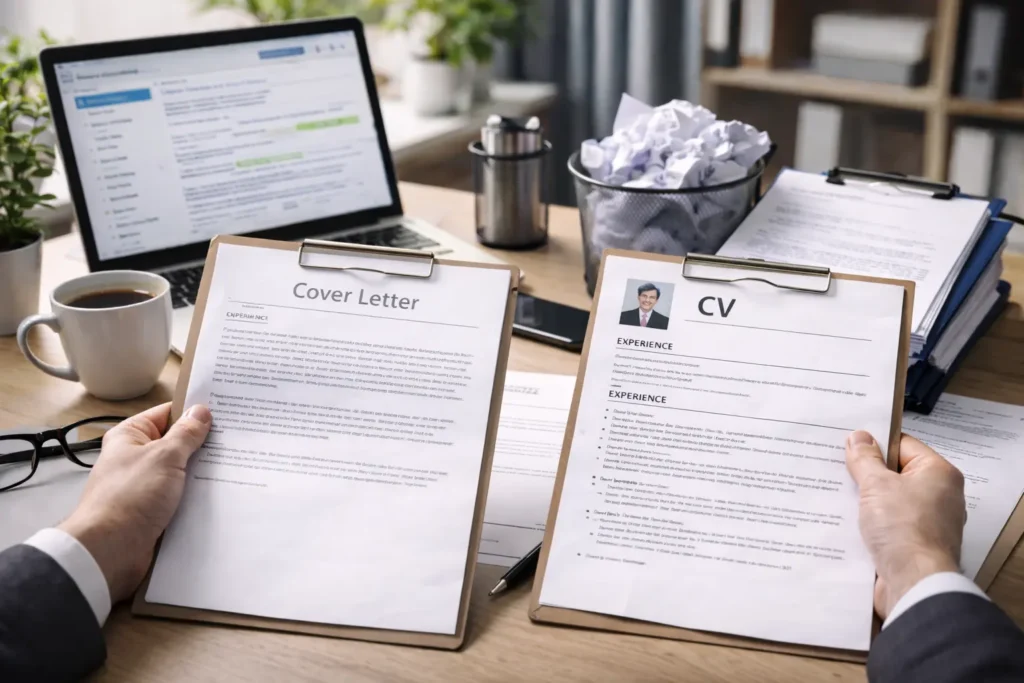
The easiest way to improve your application is to fix how your cover letter supports your CV.
Repeating your CV word-for-word wastes the recruiter’s time. Your cover letter should add context about why you want this job and how your experience connects to their needs. For example, a candidate explained their transition from teaching to corporate training, which landed them three interviews after months of rejections.
But wait, there’s more to avoid. Generic cover letters that don’t reference the company name or job search specifics also get ignored.
For instance, when you write “I’m excited about this opportunity,” recruiters know you’ve sent the same letter everywhere. It’s best if you mention the company by name and reference something specific from the job description.
The last mistake is submitting a cover letter when one was not requested. Some applicant tracking systems flag unsolicited documents. If the posting doesn’t ask for one, skip it and make your CV perfect instead.
Now that you know what’s holding your CV back, here’s how to fix it fast.
Apply These CV Writing Tips Tomorrow
Most job seekers send dozens of applications without hearing back because their CVs get filtered out in seconds. Small changes to your format, bullet points, and keyword matching can double your callback rate. Plus, these changes get you past the systems blocking qualified candidates.
We’ve covered why recruiters reject CVs and which fonts break ATS systems. You’ve learned how to rewrite weak bullets with action verbs and why matching job titles to postings increases callbacks.
Without wasting anymore time, fix your resume today. At Brian Mathews, our team will guide you through every strategy you need to stand out to hiring managers and land your next role. So, stop sending applications into the void.






 </a
</a